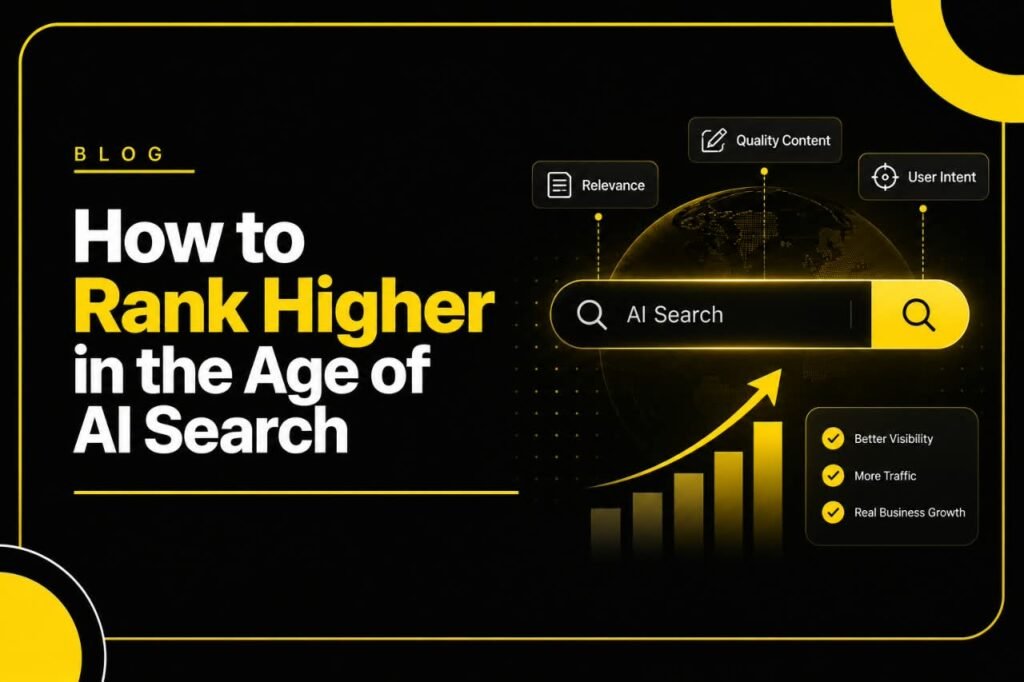
HOW TO IMPROVE SEARCH RANKINGS IN AI ERA
How to improve search rankings in AI Era
Imagine a customer searching online for a solution and receiving an AI-generated answer before visiting any website. For businesses, this changes how potential customers discover information and decide which brands deserve their attention.
Search engines are evolving, and AI-powered search experiences are becoming another way for people to find answers. Businesses that want to improve their online visibility need to understand these changes without abandoning the SEO practices that already help their websites perform.
Learning how to rank higher in the age of AI involves creating useful content, understanding search intent, improving website quality, and building credibility. There is no guaranteed shortcut to the top of search results. However, a thoughtful SEO strategy can help businesses create better opportunities to be discovered by their target audience.
1. Understand How AI Is Changing Search
People increasingly use conversational questions to explore topics, compare products, and solve problems. Instead of searching only for short phrases, they may ask detailed questions that explain their situation.
For example, a business owner might ask how to attract local customers without spending heavily on advertising.
Businesses should study the questions their audiences ask and develop content that responds to those needs. AI search visibility depends on several factors, and no particular writing format guarantees inclusion in AI-generated answers.
2. Continue Following SEO Fundamentals
AI search does not make traditional SEO unnecessary. Search engines still need to discover and understand website content.
Focus on relevant keyword research, descriptive page titles, useful headings, internal links, mobile usability, and technical website health. Check whether important pages are indexed and accessible to search crawlers.
For example, a service provider with valuable blog content may still struggle to attract visitors if the website contains broken links or confusing navigation. Fixing these issues provides a stronger foundation for search visibility.
3. Create Original and Helpful Content
Publishing another article that repeats widely available information may give readers little reason to choose your website.
Instead, include original examples, practical explanations, personal experience where relevant, and insights that help readers make decisions.
Suppose a digital marketer writes about social media engagement. Rather than listing generic tips, the article could explain how a local bakery might turn frequently asked customer questions into useful content ideas.
The example makes the advice easier to understand and apply. When creating content, prioritise usefulness and accuracy instead of producing articles simply to increase publishing frequency.
4. Understand Search Intent
Someone looking for an SEO definition needs different information from someone searching for professional SEO services.
Identify whether your audience wants to learn something, solve a problem, compare options, or make a purchase.
Then choose a suitable page format. An educational blog can explain a process, while a service page can describe what a business offers and how customers can enquire.
5. Organise Content Clearly
A well-structured article helps readers navigate information without unnecessary effort.
Use a descriptive title, a focused introduction, meaningful subheadings, and paragraphs that explain one main idea at a time.
Explain unfamiliar terms instead of assuming every reader understands technical SEO language.
Clear organisation can help search systems interpret content, but there is no need to follow an artificial formula designed specifically for AI.
6. Demonstrate Credibility and Expertise
People want information they can trust. Businesses can strengthen credibility by explaining their recommendations, verifying factual claims, and sharing genuine experience.
For instance, a marketer who recommends a particular SEO technique should explain why it may help, when it is appropriate, and what limitations to consider.
Avoid invented case studies, unsupported statistics, or exaggerated promises about ranking results. Keep website information accurate and provide an author biography where appropriate.
Trust grows when the information on a website is supported by honest communication and consistent quality.
7. Improve Technical Website Quality
Review mobile usability, page loading performance, broken links, URL structure, and internal navigation. Make sure important information is available to search crawlers and that essential pages are not accidentally blocked from indexing.
Website owners using WordPress can include these checks in their regular maintenance routine.
Technical improvements do not guarantee higher rankings, but they can remove problems that interfere with website accessibility and user experience.
8. Use AI Tools Carefully
AI tools can assist with brainstorming, organising research, identifying content gaps, and reviewing drafts. However, AI-generated material may contain inaccurate information or repeat familiar explanations.
Use AI as a supporting tool rather than allowing it to determine the entire content strategy.
Research the topic, verify claims, add relevant examples, and review the final article before publishing. The finished content should reflect the needs of your audience and the knowledge you can confidently support.
9. Measure and Improve Your SEO Strategy
SEO requires ongoing observation. Use Google Search Console to review search impressions, clicks, queries, and the performance of individual pages.
For example, if an article attracts visitors but generates few enquiries, review whether it answers the right questions and provides a useful next step.
Make changes based on evidence rather than reacting to every short-term fluctuation. Remember that AI search visibility is not always reported as a separate traffic category, so available data may not reveal every discovery source.
Conclusion
Ranking higher in the age of AI requires a combination of useful content, sound SEO practices, technical website quality, and credibility.
AI tools can support research and content creation, but human judgement remains important for accuracy, relevance, and originality. By understanding search intent, maintaining a reliable website, and improving content based on real performance data, businesses can build a stronger foundation for online visibility.
There is no guaranteed way to secure the highest position in search results or appear in every AI-generated answer.
What does SEO mean in the AI era?
SEO in the AI era means improving a website so people can discover its content through traditional search engines and newer AI-powered search experiences. It combines useful information, technical website quality, relevant keywords, and trustworthy content.
How can businesses improve their search rankings today?
Businesses can strengthen their search performance by publishing helpful content, understanding customer search intent, improving website speed and mobile usability, using relevant keywords naturally, and maintaining a clear website structure.
Can AI-generated content rank on search engines?
AI-assisted content can perform well when it provides useful, accurate, original information that meets readers’ needs. However, using AI does not automatically improve rankings. Content should be carefully reviewed, fact-checked, and enhanced with meaningful insights.
What technical improvements can support better search rankings?
Important areas include mobile-friendly design, fast page loading, secure browsing, accessible navigation, working internal links, and correct indexing settings. These improvements help search engines access website content and help visitors use the site comfortably.